Building Reliable FastAPI Services in Production: Timeouts, Retries, Idempotency, and Observability
A production-focused guide to making FastAPI services resilient with deadlines, bounded retries, idempotency, database safeguards, backpressure, and observability.
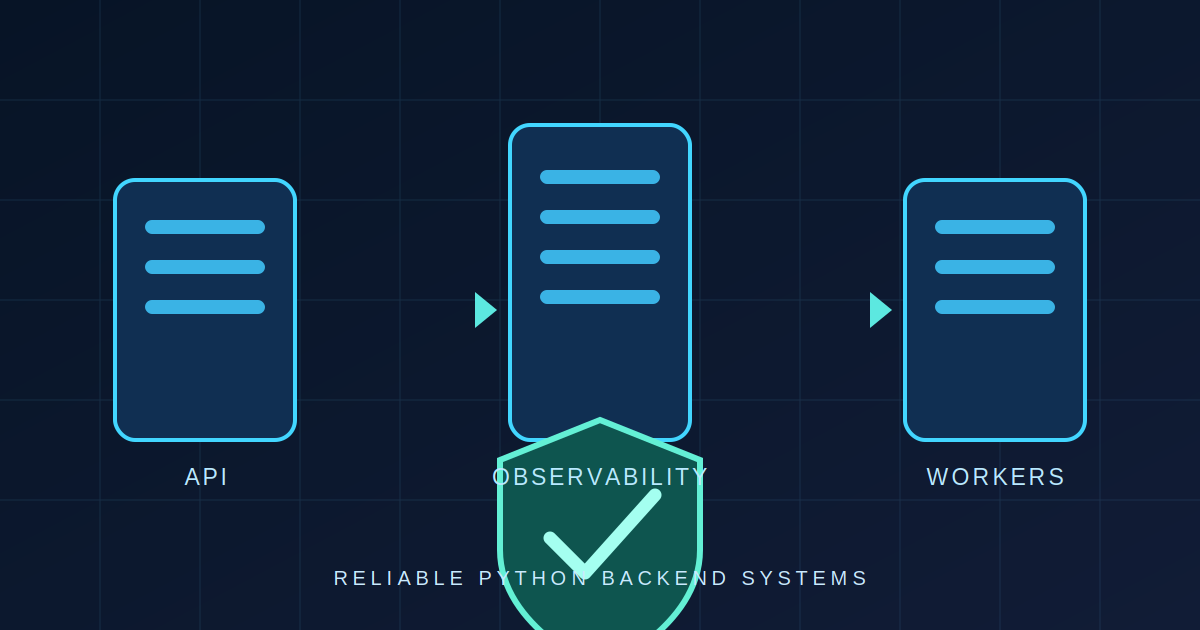
A FastAPI endpoint can look perfectly healthy in development and still become a reliability problem under production traffic. A downstream service slows down, requests accumulate, clients retry, database connections run out, and a small dependency failure turns into a wider outage. The framework is rarely the root cause. The missing pieces are usually explicit time budgets, bounded concurrency, safe retries, idempotent writes, and useful operational signals.
This guide presents a practical reliability baseline for Python APIs built with FastAPI. It focuses on the boundaries that matter: inbound requests, outbound HTTP calls, database transactions, background work, and production observability. The examples are intentionally small, but the design principles apply to larger services and distributed systems.
1. Start with a request budget, not an arbitrary timeout
Every request should have a finite time budget. If an API gateway allows a request to run for 30 seconds, spending 25 seconds waiting on one downstream dependency leaves almost no time for database work, serialization, or returning a useful response. Set an end-to-end deadline and allocate smaller budgets to each dependency.
For example, a 5-second API budget might reserve 500 ms for authentication and validation, 2 seconds for a critical downstream call, 1 second for database work, and the remaining time for orchestration and response handling. These are illustrative budgets, not universal defaults: derive them from the product's latency objective and measured dependency behavior.
BoundaryReliability ruleWhy it matters Inbound requestEnforce an overall deadlinePrevents requests from occupying workers indefinitely HTTP dependencyUse connect and read timeoutsBounds network connection and response waiting DatabaseBound pool waits and statement durationPrevents connection exhaustion and runaway queries RetriesUse a total retry budgetStops retries from multiplying outage traffic Background workPersist work that must survive process restartsAvoids losing jobs held only in memory2. Reuse outbound HTTP clients and set explicit limits
Creating a new HTTP client for every request wastes connection setup and prevents efficient connection pooling. Use a long-lived client managed by the application lifespan. Configure timeouts and connection limits explicitly, and close the client during shutdown.
from contextlib import asynccontextmanager
import httpx
from fastapi import FastAPI, Request, HTTPException

@asynccontextmanager
async def lifespan(app: FastAPI):
    app.state.partner_client = httpx.AsyncClient(
        timeout=httpx.Timeout(connect=0.5, read=2.0, write=1.0, pool=0.5),
        limits=httpx.Limits(
            max_connections=100,
            max_keepalive_connections=20,
            keepalive_expiry=30.0,
        ),
    )
    try:
        yield
    finally:
        await app.state.partner_client.aclose()

app = FastAPI(lifespan=lifespan)

@app.get("/partner-status")
async def partner_status(request: Request):
    try:
        response = await request.app.state.partner_client.get(
            "https://partner.example.com/health"
        )
        response.raise_for_status()
        return {"partner": "available"}
    except httpx.TimeoutException:
        raise HTTPException(status_code=504, detail="Partner timed out")
    except httpx.HTTPError:
        raise HTTPException(status_code=502, detail="Partner request failed")
The example maps timeout and upstream failures to gateway-style responses. Avoid returning raw dependency exceptions or response bodies to clients. Log the dependency name, request correlation ID, and failure category internally, without exposing credentials or sensitive payloads.
3. Retry only when the operation is safe
Retries are not a generic fix for errors. They are appropriate for selected transient failures, such as connection resets, rate limits with a valid retry hint, or temporary upstream server errors. They are usually inappropriate for validation errors, authentication failures, and most other 4xx responses.
Use exponential backoff with jitter, a small maximum attempt count, and a total deadline. Jitter prevents many clients from retrying at exactly the same moment. A retry policy must also respect the downstream service's rate limits and retry-after instructions.
import asyncio
import random
import httpx

async def get_with_bounded_retries(
    client: httpx.AsyncClient,
    url: str,
    attempts: int = 3,
) -> httpx.Response:
    for attempt in range(attempts):
        try:
            response = await client.get(url)
            if response.status_code not in {429, 500, 502, 503, 504}:
                response.raise_for_status()
                return response
            if attempt == attempts - 1:
                response.raise_for_status()
        except (httpx.TimeoutException, httpx.NetworkError):
            if attempt == attempts - 1:
                raise

        delay = min(0.2 * (2 ** attempt), 1.5)
        await asyncio.sleep(delay + random.uniform(0, delay * 0.25))

    raise RuntimeError("unreachable")
This helper is illustrative: production code should parse and cap Retry-After, distinguish connect from read failures where useful, and include the overall request deadline. Most importantly, do not blindly retry a non-idempotent POST. A timeout does not prove the server failed to process the request.
4. Make write endpoints idempotent
Clients retry. Proxies retry. Mobile networks drop connections. A client may send a payment or order request, the server may commit it, and the response may disappear before the client receives it. If the client retries without an idempotency mechanism, the business operation can happen twice.
Accept an idempotency key for operations where duplicate execution would be harmful. Store the key, request fingerprint, and result in the same database transaction as the business change. A unique constraint handles concurrent duplicate requests safely.
CREATE TABLE idempotency_records (
    key             TEXT PRIMARY KEY,
    request_hash    TEXT NOT NULL,
    response_json   JSONB,
    created_at      TIMESTAMPTZ NOT NULL DEFAULT now()
);
from fastapi import Header, HTTPException

@app.post("/orders")
async def create_order(
    payload: CreateOrder,
    idempotency_key: str = Header(alias="Idempotency-Key"),
):
    if not idempotency_key:
        raise HTTPException(status_code=400, detail="Idempotency-Key required")

    # In one database transaction:
    # 1. Insert the key and canonical request hash.
    # 2. If the key already exists, compare request hashes.
    # 3. Return the stored result for an identical completed request.
    # 4. Reject reuse of the same key with a different request body.
    # 5. Create the order and persist the response before commit.
    return await order_service.create_idempotently(payload, idempotency_key)
The service method above represents the transaction boundary; it must not be implemented as separate commits. Define how long keys remain valid, how in-progress requests are represented, and what happens when a client reuses a key with a different payload. Idempotency is a business contract, not just a header.
5. Protect the database pool and transaction boundary
Database pools are finite. If every request waits indefinitely for a connection, latency rises until the service stops making progress. Set pool size and acquisition timeout based on the database's connection budget and the number of application workers. Remember that each worker process may own its own pool.
Keep transactions short. Do not hold a database transaction open while calling a remote API, sending email, or waiting for user input. For workflows that need both a database update and an asynchronous event, write an outbox record in the same transaction and publish it from a separate relay. That avoids coupling database locks to network latency.
Use database-side statement timeouts for expensive or runaway queries, and ensure cancellation propagates through async code. A request timeout that only stops waiting at the HTTP layer does not necessarily stop the database query or remote operation.
6. Bound concurrency and apply backpressure
Async I/O makes it inexpensive to wait on sockets, but it does not make downstream capacity unlimited. A sudden increase in concurrent requests can overwhelm a partner API, database pool, or internal queue. Use explicit concurrency limits around scarce dependencies and reject or defer excess work rather than allowing an unbounded queue to grow.
For CPU-heavy work, move execution to a process pool or a dedicated worker system. Running CPU-bound Python code directly in an async route blocks the event loop. For work that must survive restarts or be retried independently, use a durable queue or job system rather than an in-memory background task.
7. Make observability part of the API contract
Logs alone are not enough. A reliable service needs metrics for request rate, error rate, latency percentiles, saturation, dependency failures, and queue depth. Use structured logs and propagate a request or trace ID across service boundaries. Instrument outbound calls separately so a slow dependency is visible instead of being hidden inside a generic endpoint latency metric.
- Traffic: request rate by route and method.
- Errors: 4xx and 5xx rates, timeout counts, and dependency error classes.
- Latency: p50, p95, and p99 by route and downstream dependency.
- Saturation: worker utilization, active requests, event-loop lag, and database pool wait time.
- Queues: queue depth, oldest message age, retry count, and dead-letter volume.
Do not use raw user IDs, email addresses, or arbitrary request values as metric labels; high-cardinality labels can make monitoring expensive and unstable. Keep sensitive information out of logs and traces. Define alerts around user-visible symptoms and service-level objectives, not every individual exception.
8. Test failure paths deliberately
Happy-path tests prove that the service works when everything is healthy. Reliability tests prove that it behaves predictably when dependencies fail. Simulate a slow upstream, connection refusal, malformed response, database pool exhaustion, duplicate idempotency key, and client cancellation. Verify that timeouts are enforced, retries remain bounded, and the service recovers without manual intervention.
Load-test with realistic concurrency and payload sizes. Watch p95 and p99 latency, connection-pool waits, memory growth, and downstream saturation. Test graceful shutdown while requests are active, and confirm that durable background work is not lost. A service is not production-ready simply because it returns HTTP 200 in a local test.
9. A production readiness checklist
- Define an end-to-end request deadline and smaller dependency timeouts.
- Reuse outbound HTTP clients and configure connection limits.
- Retry only transient failures, with jitter, bounded attempts, and a total deadline.
- Require idempotency keys for duplicate-sensitive write operations.
- Keep database transactions short and set pool and statement timeouts.
- Apply concurrency limits and backpressure to scarce dependencies.
- Move durable or CPU-heavy work out of request handlers.
- Instrument latency, errors, saturation, and dependency health.
- Test dependency failures, duplicate requests, cancellation, and graceful shutdown.
Conclusion
FastAPI provides an efficient foundation for Python services, but production reliability comes from the boundaries around the framework. Explicit deadlines prevent requests from hanging, bounded retries avoid amplifying outages, idempotency protects business operations from duplicate delivery, and observability makes failure diagnosable. Combine these practices with short database transactions, backpressure, and deliberate failure testing to build APIs that remain predictable under real-world conditions.
Further reading
Related articles
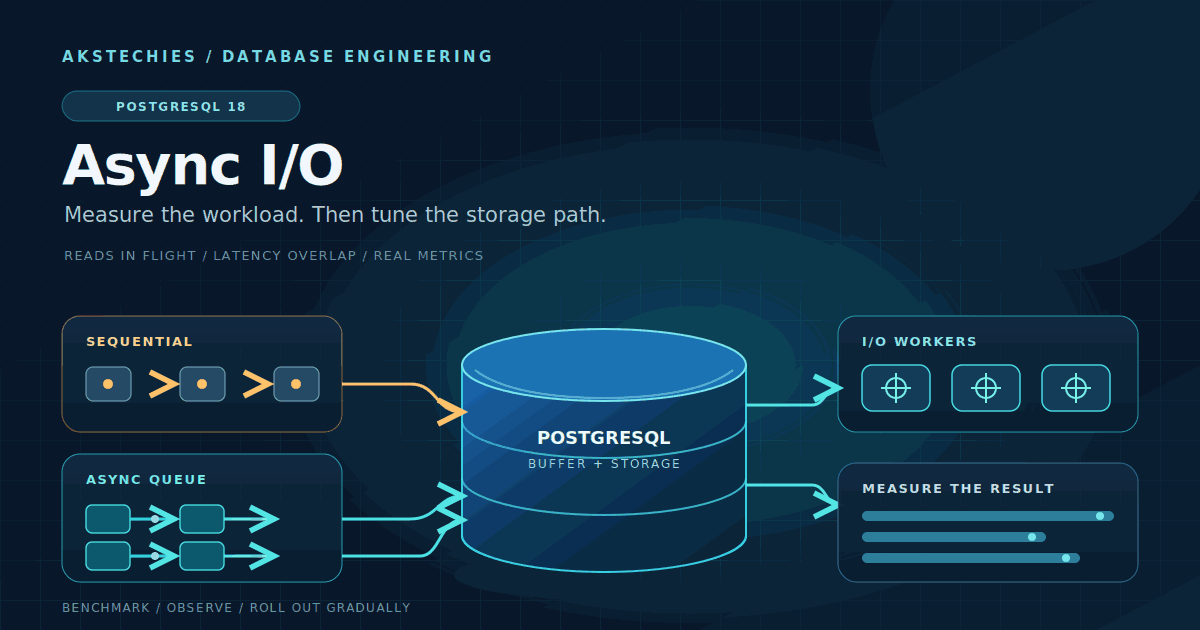
PostgreSQL Async I/O: How to Measure Before You Tune
A practical PostgreSQL 18 guide to asynchronous I/O: understand io_method, benchmark scan-heavy workloads, read pg_stat_io, and roll out tuning safely.
Read article
Python asyncio TaskGroups: Structured Concurrency That Survives Cancellation
A production-focused guide to Python 3.11+ asyncio TaskGroups: child-task ownership, sibling cancellation, ExceptionGroup handling, deadlines, and safe fan-out patterns.
Read article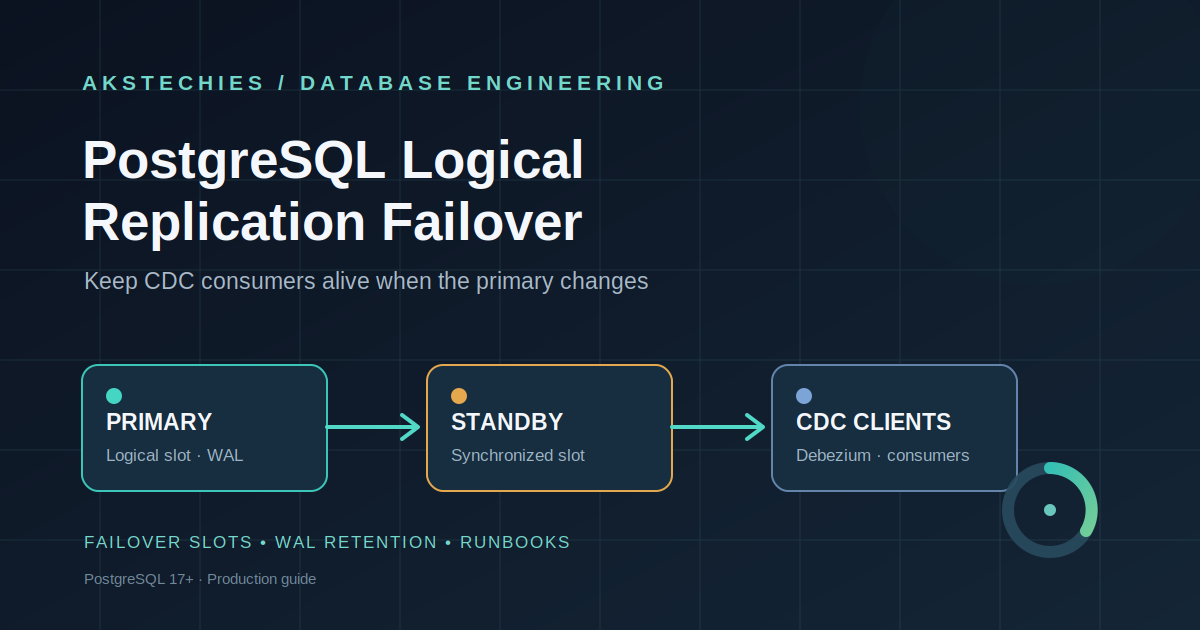
PostgreSQL Logical Replication Failover: Keep CDC Running After Promotion
A production guide to PostgreSQL 17+ logical failover slots: configure slot synchronization, protect WAL, verify standby readiness, and recover CDC consumers safely after promotion.
Read articleLet's talk
Have an idea? Let's figure out how to build it.
You don't need a technical specification or a perfectly defined plan. Tell us what you're trying to achieve, and we'll help identify the next steps.